
Healthcare today is shifting away from rigid, desk-bound routines toward care that is faster, more connected, and built around the patient. Every November, thousands of healthcare leaders, engineers, and clinicians walk the halls of MEDICA, the world’s largest medical trade fair.
Leading shows and conversations center on three big shifts:
- First, building the Smart Hospital.
- Second, bringing point-of-care diagnostics directly to the bedside,
- Lastly, expanding telemedicine and remote monitoring.
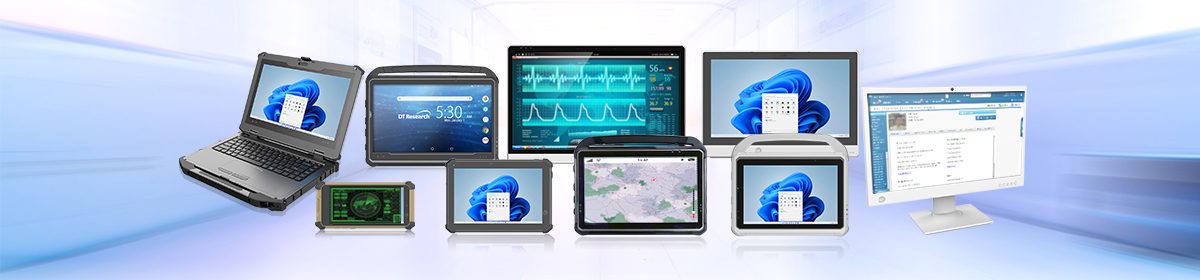
While advanced surgical robotics and emerging medical technologies continue to transform healthcare, some of the most significant improvements in clinical efficiency come from the technology devices healthcare professionals rely on every day. Medical tablets and All-in-One (AIO) computers play an essential role in streamlining workflows, improving access to patient information, and supporting more connected, efficient care delivery.
While innovations in artificial intelligence, biosensors, and remote patient monitoring continue to advance healthcare, their effectiveness depends on reliable computing technology that supports daily clinical operations. Medical tablets and mobile computing solutions must withstand the demands of busy healthcare environments, including extended shifts, accidental drops, and frequent cleaning with hospital-grade disinfectants. Purpose-engineered medical-grade computers from DT Research provide the durability, dependable performance, and mobility healthcare professionals need to maintain uninterrupted workflows and deliver efficient, high-quality patient care.
At DT Research, we design medical tablets and All-in-One (AIO) computers specifically for the realities of clinical work. Looking closely at the core themes shaping MEDICA shows how the right computing foundation turns ambitious digital health goals into everyday clinical habits.
1. Building the Smart Hospital Without Slowing Down Staff
The “Hospital of the Future” is no longer a distant concept. It is a top strategic priority for hospital executives trying to balance rising patient demand, tight staffing, and strict data privacy rules. True digital transformation connects electronic health records (EHRs), smart operating rooms, and AI-assisted scheduling so clinical teams spend less time hunting for information and more time with patients.
Yet many hospitals hit a wall when new software runs on outdated or mismatched hardware. Bulky desktop towers trap nurses behind central stations, while noisy cooling fans blow potentially harmful particulates across sensitive rooms.
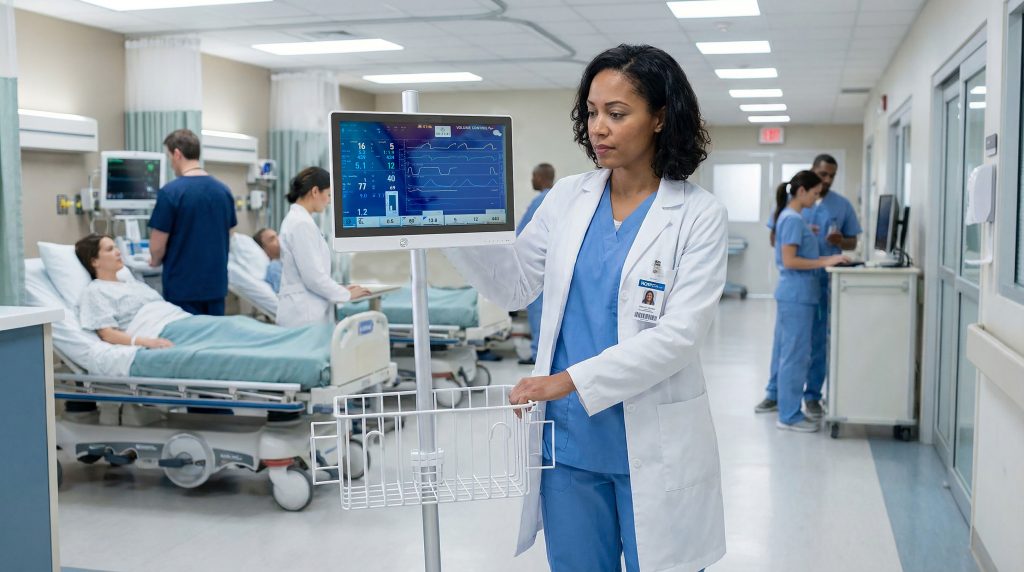
Purpose-engineered medical AIO computers remove those barriers right where care happens:
- Clean, Quiet Workstations: Models like the DT Research DT514 and DT584 medical AIO computers pack full desktop performance into slim, fanless enclosures. With no open vents or spinning fans, they run silently and prevent airborne dust and microbes from circulating in patient rooms or surgical suites.
- Built-In Hygiene and Safety: Every DT Research medical AIO features an antimicrobial coating and an IP65-rated sealed front panel, allowing staff to wipe down screens quickly between patients without worrying about moisture damage. They also carry ANSI/AAMI ES60601-1 medical safety certification, ensuring safe electrical operation right next to patients and sensitive monitoring equipment.
- Fast, Secure Access: Long passwords waste precious minutes, especially when wearing medical gloves. Built-in smart cards and RFID/NFC readers let clinicians tap their badge to log in and out instantly, keeping patient records protected while cutting login friction.
- Ready for On-Device AI: Powered by modern Intel® Core™ Ultra processors, newer AIOs like the DT514 and compact DT574 handle AI-supported clinical tools smoothly right at the nursing station or rolling medical cart, without lagging or waiting on distant servers.
- 24/7 Operation with Hot-swappable Batteries: Built-in batteries add to ease-of-use and eliminate the need for bulky cart batteries that require the entire cart and system docked for charging and unusable. With multiple battery chargers, fully-charged batteries are always available and keep data flowing at all times.
2. Speeding Up Point-of-Care Diagnostics at the Bedside
Waiting hours for a central lab to process a routine blood panel or diagnostic scan can delay treatment when minutes matter most. That is why point-of-care testing (POCT) and portable diagnostics are expanding rapidly across emergency departments, outpatient clinics, and even home health visits. Today’s compact analyzers, portable ultrasound probes, and lab-on-a-chip tools deliver answers in minutes. However, clinicians must have a mobile computer capable of capturing, viewing, and syncing that data on the spot.
This is where rugged medical tablets bridge the gap between portable diagnostic tools and the hospital’s main IT network:
- True Mobility Across Every Department: DT Research medical tablets such as the compact 10.1-inch DT302MD, the 13.3-inch DT323MD, and the larger 15.6-inch DT316MD are light enough to carry from room to room yet tough enough to survive drops, bumps, and constant sanitization.
- Non-Stop Shifts with Hot-Swappable Batteries: A dead battery mid-shift is more than an annoyance; it interrupts care. DT Research medical tablets feature hot-swappable battery packs. When power runs low, a nurse simply swaps in a fresh battery in seconds without shutting down the tablet or closing an active patient chart.
- Accurate Verification in One Step: Integrated 2D barcode scanners and RFID readers allow clinicians to scan a patient’s wristband, match it to a bedside test sample, and upload results straight into the EHR in seconds, eliminating manual transcription errors and ensuring diagnostic data reaches specialists immediately.
- High-definition Screen for Detailed Review: Whether reviewing a bedside ultrasound on a 17-inch DT373MD tablet or examining high-resolution diagnostic scans on a DT554 medical graphics station, wide-viewing-angle displays ensure physicians see fine clinical details clearly without squinting.
3. Making Telemedicine and Remote Monitoring Seamless
Care doesn’t stop when a patient walks out of the hospital doors. Sensor-based wearables, virtual follow-up visits, and remote patient monitoring help clinics manage chronic conditions earlier and keep recovery on track, especially in regions facing clinician shortages and crowded outpatient schedules.
Still, telemedicine only succeeds when the technology feels natural for both the care team and the patient. If a virtual consult requires wheeling in a tangle of separate webcams, microphones, and power cords, busy staff simply will not use it.
DT Research simplifies connected care by building audio, video, and wireless reliability directly into its medical systems:
- All-in-One Virtual Consult Stations: Mounted on a rolling cart with integrated hot-swappable batteries, a DT582 medical-cart AIO computer becomes an instant mobile telehealth hub. Equipped with an integrated high-resolution camera, microphone array, and clear speakers, it lets bedside nurses bring a remote cardiologist or specialist directly into the patient’s room with a single tap.
- Connected Care Anywhere: For visiting nurses and mobile care teams checking in on homebound patients, medical tablets with built-in WiFi 6/7 and optional 4G/5G connectivity maintain steady, encrypted connections back to the clinic. Clinicians can review wearable sensor trends, update care plans, and hold clear video check-ins right from a patient’s living room.
- Flexible Form Factors for Tight Spaces: Not every exam room or outpatient pod has space for a full-sized workstation. Compact medical AIOs like the DT573 (15.6”) and DT556 (17.3”) mount cleanly onto walls, desk arms, or lightweight stick carts, giving smaller spaces reliable telehealth and patient-intake stations without crowding the room.
Practical Tech Built Around Real People
Healthcare technology succeeds only when it respects how clinicians actually work. Doctors and nurses do not need flashier gadgets. Instead, they need computers that turn on instantly, stay clean, never run out of power mid-shift, and share patient data without friction.
By pairing rugged medical tablets with quiet, antimicrobial all-in-one computers, DT Research helps healthcare organizations turn smart hospital strategies, rapid bedside diagnostics, and connected remote care into smooth, reliable daily practice.
Ready to see how purpose-engineered medical computing fits your facility? Explore the full line of DT Research Medical Tablets and AIO Computers to find the right fit for your clinical teams.