
Modern healthcare moves quickly, and care is no longer confined to a traditional hospital setting. Clinicians are working across busy medical facilities, rural clinics, mobile environments, and virtual care settings, while patients increasingly expect reliable access to quality care wherever they are. Telehealth has evolved from a convenient option into an essential part of the healthcare ecosystem, making the technology that supports it more important than ever.
For telehealth professionals, ease of use, reliability, and workflow efficiency are critical. Technology should simplify the consultation experience, not create additional steps or distractions. Medical all-in-one (AIO) systems can help provide that flexibility by combining powerful computing, intuitive operation, and clinical-ready functionality in a streamlined, small-footprint design. This gives providers greater control over virtual care workflows while helping them stay focused on what matters most: the patient.
The Evolution of the Virtual Exam Room
When telehealth services first became popular, they were often done on a shoestring budget. Clinicians would use whatever they could find in order to provide services to their clients remotely, and this often left them with less than ideal equipment.
For doctors and nurses who provide telehealth services, having to work around the limitations of a home PC or an unreliable camera on a rolling stand can be incredibly frustrating. When doing business from home, providers have to rely on their own technology to get their services online.
By consolidating everything into a single, powerful healthcare-focused display-integrated computing system, telehealth providers get the most out of their consultations while being able to put up or change any information and visuals they wish.
Why You Need Medical-Grade AIO Computers
While you might think that any computer will do, there are many advantages to be had when using medical-grade computers.
Here’s a look at what sets precision-engineered medical all-in-one computers uniquely suited for modern telehealth workflows:
1. Powerful Displays and Speakers for Telehealth Conferences
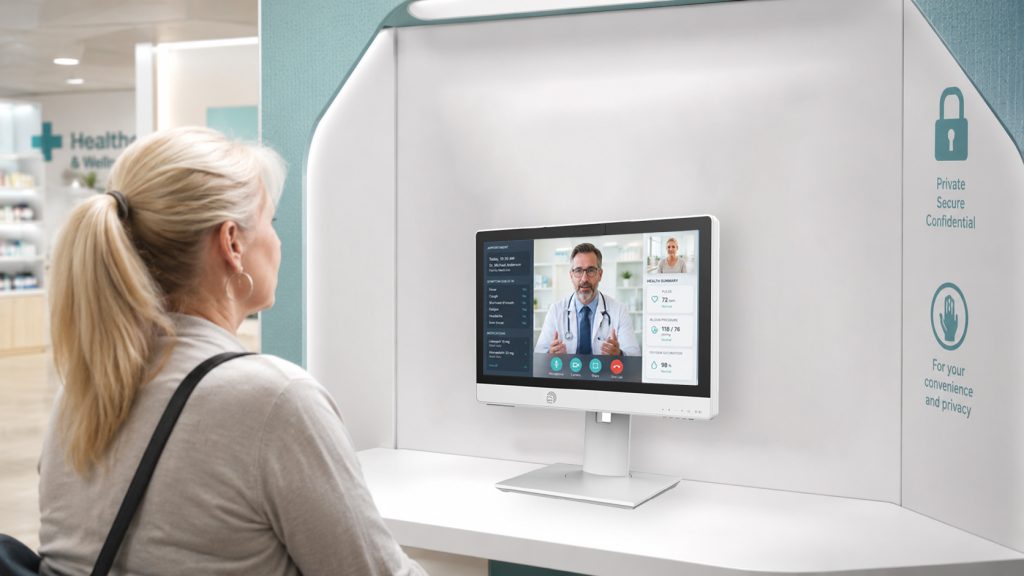
In telehealth, your screen is your stethoscope. Clinicians rely on high-resolution displays (Full HD or 4K) to spot subtle skin conditions, review complex X-rays, or gauge a patient’s physical issues over video. Integrated high-definition cameras, noise-suppressing microphones, and powerful speakers ensure that communication feels natural, bridging the physical gap between doctor and patient.
2. Space-Saving Telemedicine Systems
Space is a premium in any medical facility, and telehealth providers often have to make do with whatever room they can find. By consolidating medical all-in-one systems and displays into a single piece of equipment, you can free up valuable space in your facility. This lets you dedicate more room to other aspects of your practice, such as additional workstations or medical equipment. All-in-one systems combine computing power and display into one footprint, freeing up valuable space. Mounted easily on walls, swing arms, or medical carts, they adapt effortlessly to wherever care is happening.
3. Sanitation and Safety in Telehealth Environments
Keeping telehealth workstations clean can be difficult, and some providers opt for basic consumer off-the-shelf computers.
However, this can come at the cost of reliability in the long run. Medical-grade AIO computers feature antimicrobial coating, IP-rated front panels, and fanless operation. They are engineered to withstand continuous wipe-downs without compromising internal components and reduce circulation of airborne contaminants, protecting both staff and patients.
4. State-of-the-Art Telemedicine Hardware
Telemedicine is set to become a dominant force in the near future, and cutting-edge technology is being developed and applied to the industry at an astonishing rate. Clinicians looking to make a name for themselves should be using the best telehealth technology available. Modern medical all-in-one systems are capable of running the most demanding programs, including AI-assisted diagnosis and treatment progress monitoring.
How Medical All-in-One Computers Streamline Your Practice
The true value of medical all-in-one computers is their ability to simplify the technology experience so telehealth providers can stay focused on patient care.
With a high-performance AIO workstation, clinicians can access electronic health records, review live vital signs, update care notes, share diagnostic images, and maintain a face-to-face video connection from a single streamlined platform. Reducing the need to move between multiple devices or disconnected systems helps create a smoother, more efficient consultation experience.
By minimizing workflow friction and keeping essential clinical information within easy reach, medical AIO systems can help reduce administrative burden, support greater accuracy, and create a more connected, patient-centered telehealth experience.
The Future of Telehealth Services
As telehealth continues to mature, the distinction between in-person and virtual care will become increasingly seamless. Healthcare organizations are already moving toward more connected models that allow clinicians to support patients across hospitals, clinics, mobile environments, and remote locations using the same digital ecosystem.
Medical all-in-one computers can play an important role in that transition by giving providers a reliable platform for virtual consultations, access to clinical data, diagnostic review, and real-time communication. Investing in purpose-engineered telehealth technology today can help healthcare organizations expand access, improve workflow flexibility, and prepare for a future where care is delivered wherever the patient needs it.